
She has authored several books including The Century of the Gene in which she argues that the gene is not the prime engine of evolutionary creativity. Her latest book published in 2010 is titled The Mirage of a Space between Nature and Nurture.

Evelyn Fox Keller received her Ph.D in Physics from Harvard in 1963. Yet, she has strong interests in molecular biology, which is reflected in her thesis ("Photoinactivation and the Expression of Genetic Information in Bacteriophage-Lambda). She has been teaching at MIT since 1992. Earlier, she has taught at Northeastern University, University of California, Berkeley , University of Maryland, Northwestern University , State University of New York at Purchase, New York University, Princeton, Cornell and in Northwestern University.
She has authored several books including The Century of the Gene in which she argues that the gene is not the prime engine of evolutionary creativity. Her latest book published in 2010 is titled The Mirage of a Space between Nature and Nurture.
We’ve been under the spell of DNA for too long. Science historian and MacArthur Fellow Evelyn Fox Keller makes the case for radically new thinking about the nature of heredity in The Century of the Gene. This short, magisterial treatise examines 100 years of genetic thinking and finds outdated elements of Victorian beliefs still permeating our scientific writing. Despite compelling evidence that cytoplasmic and other nonchromosomal factors play important roles in development and even in the inheritance of traits, most discussion still relies on the master-slave (or manager-worker) relationship between the nucleus and the cell. Keller wants to move on; her proximate goal is to proceed from talking about genes to talking about genetic talk, the better to understand our biases. Her excitement at developments such as the Human Genome Project, despite her initial doubts, is only heightened by the prospect of vast stretches of uncharted intellectual territory. Ultimately, of course, her program matches that of the scientific enterprise—to more fully understand ourselves and our world. What comes after The Century of the Gene? It’s an excellent question, and one that can only be answered once we leave behind the baggage of the past. – (Amazon.com review by Rob Lightner)
In this powerful critique, the esteemed historian and philosopher of science Evelyn Fox Keller addresses the nature-nurture debates, including the persistent disputes regarding the roles played by genes and the environment in determining individual traits and behavior. Keller is interested in both how an oppositional “versus” came to be inserted between nature and nurture, and how the distinction on which that opposition depends, the idea that nature and nurture are separable, came to be taken for granted. How, she asks, did the illusion of a space between nature and nurture become entrenched in our thinking, and why is it so tenacious? Keller reveals that the assumption that the influences of nature and nurture can be separated is neither timeless nor universal, but rather a notion that emerged in Anglo-American culture in the late nineteenth century. She shows that the seemingly clear-cut nature-nurture debate is riddled with incoherence. It encompasses many disparate questions knitted together into an indissoluble tangle, and it is marked by a chronic ambiguity in language. There is little consensus about the meanings of terms such as nature, nurture, gene, and environment. Keller suggests that contemporary genetics can provide a more appropriate, precise, and useful vocabulary, one that might help put an end to the confusion surrounding the nature-nurture controversy.
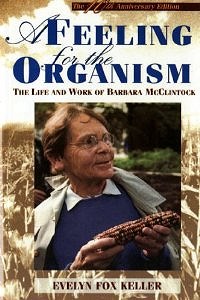
For much of her life she worked alone, brilliant but eccentric, with ideas that made little sense to her colleagues. Yet before DNA and the molecular revolution, Barbara McClintock’s tireless analysis of corn led her to uncover some of the deepest, most intricate secrets of genetic organization. Nearly forty years later, her insights would bring her a MacArthur Foundation grant, the Nobel Prize, and long overdue recognition. At her recent death at age 90, she was widely acknowledged as one of the most significant figures in 20th-century science.
Evelyn Fox Keller’s acclaimed biography, A Feeling for the Organism, gives us the full story of McClintock’s pioneering—although sometimes professionally difficult—career in cytology and genetics. The book now appears in a special edition marking the 10th anniversary of its original publication.
Reflections on Gender and Science (1985)
Making Sense of Life: Explaining Biological Development with Models, Metaphors and Machines (2002)