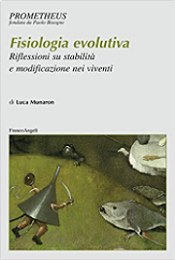
The book is in Italian (will be translated into English)
The extraordinary variety of life forms we have the privilege of admiring and describing is so complex that it lends itself only approximately to our often limping and uncertain attempts at classification. The meager paleontological finds, remains of the structures of ancient animals, are the only guide to anatomy, the narrow eye of the needle that embroider the phenotypes of the past and gives an account of those present. But reconstructing the vital functions, tracing the currents of the evolution of physiology, means working with empty hands, indirect evidence and some fragile suggestions. The processes are impalpable, they leave only traces of their own journey. We know that life has its roots in a terrain rich in complexity, with its redundancy of forms and functions. We recognize that not everything is possible due to constraints that seem to pervade the universe and generate the most disparate compromises. We understand at least in part the rules of time and space in which life is realized and transformed. We are also aware that our mental schemes, vehicles of knowledge, vacillate in the face of natural dynamics because they are themselves a product of them. It is undoubtedly a difficult undertaking to offer at least plausible historical reconstructions and a coherent narration of the events that have followed biological evolution. The experimental data constitute the most tangible link with the world, but the weight of their restrictions and the rational interpretation assigned to them gives us back what Antonio Tabucchi called “a truth full of holes” to which only intuition confers completeness. Or the dream. The insistent references to the history and philosophy of biology, supplemented by examples taken from architecture, design, engineering and psychology, lead the reader through a narrow and winding road, in which the models of explanation are attempts to procure provisional and partial answers and what the most important is knowing how to ask the most appropriate questions. This essay is designed for readers of various backgrounds and cultures, from students of biological and naturalistic degree courses to non-specialists, interested in themes of history and evolution that involve us and question our innermost nature.