Books
-
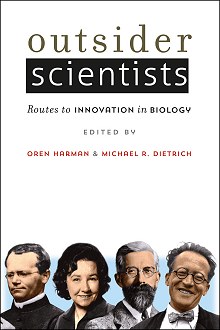
Outsider Scientists: Routes to Innovation in Biology
Author:
Outsider Scientists describes the transformative role played by "outsiders" in the growth of the modern life sciences. Biology, which occupies a special place between the exact and human sciences, has historically attracted many thinkers whose primary training was in other fields: mathematics, physics, chemistry, linguistics, philosophy, history, anthropology, engineering, and even literature. These outsiders brought with them ideas and tools that were foreign to biology, but which, when applied to biological problems, helped to bring about dramatic, and often surprising, breakthroughs.
This volume brings together eighteen thought-provoking biographical essays of some of the most remarkable outsiders of the modern era, each written by an authority in the respective field. From Noam Chomsky using linguistics to answer questions about brain architecture, to Erwin Schrodinger contemplating DNA as a physicist would, to Drew Endy tinkering with Biobricks to create new forms of synthetic life, the outsiders featured here make clear just how much there is to gain from disrespecting conventional boundaries. Innovation, it turns out, often relies on importing new ideas from other fields. Without its outsiders, modern biology would hardly be recognizable.
-

BEEM: Biological Emergence-based Evolutionary Mechanism: How Species Direct Their Own Evolution
Author:
In BEEM, author and engineer Raju Pookottil boldly diverges from the Darwinian theory of natural selection and offers a thought provoking counter-hypothesis for the evolution of all living organisms. He proposes that every species, be it single cells, plants or animals, are equipped with the fundamental mechanisms that allows them to generate intelligent and logical decisions that they could then utilize in directing their own evolution. Whereas natural selection depends on random mutations followed by selection, Pookottil argues that species are capable of deciding how to logically construct themselves to near perfection over many generations, making modifications to their own genes where necessary.
The principles of emergence, swarm intelligence and signal networks, which he proposes are available to all living organisms, could in fact be the real forces that cleverly and logically drive the evolution of every species on earth. Our brains work by exploiting these very same principles. It is proposed that the complex signal networks that exist between the millions of protein molecules in a cell, or the billions of cells that make up larger organisms, are also capable of generating intelligent solutions, albeit at a slower pace.
The hypothesis also argues that species are in control of their own genomes and that they are able to engineer their genetic codes where necessary in order to incorporate ‘design modifications’. Thus, species meaningfully assess their environment, create ingenious solutions, and crucially, pass them on to subsequent generations. Using observable examples, BEEM builds up a strong case supporting these arguments.
-

Evolutionary Biology: Cell-Cell Communication, and Complex Disease
Author:
An integrative view of the evolution of genetics and the natural world
Even in this advanced age of genomics, the evolutionary process of unicellular and multicellular organisms is continually in debate. Evolutionary Biology, Cell–Cell Communication, and Complex Disease challenges current wisdom by using physiology to present an integrative view of the nature, origins, and evolution of fundamental biological systems.
Providing a deeper understanding of the way genes relate to the traits of living organisms, this book offers useful information applying evolutionary biology, functional genomics, and cell communication studies to complex disease. Examining the 4.5 billion-year evolution process from environment adaptations to cell-cell communication to communication of genetic information for reproduction, Evolutionary Biology hones in on the "why and how" of evolution by uniquely focusing on the cell as the smallest unit of biologic structure and function.
-
Epigenetics: How Environment Shapes Our Genes
Author:
It is time to worry again - our lifestyle choices do impact our genetic code and that of our children (and even grandchildren). Epigenetic means "on the gene" and the term refers to the recent discovery that stress can impact an individual's physiology so deeply that those biological scars are actually inherited by the next several generations. For instance, a recent study has shown that men who started smoking before puberty caused their sons to have significantly higher rates of obesity. And obesity is just the tip of the iceberg - many researchers believe that epigenetics holds the key to understanding cancer, Alzheimer's, schizophrenia, autism and diabetes. Driven by stories such as the Dutch Hongerwinter of the Second World War, Jose Canseco and steroids, the breeding of mules and hinnies, Tazmanian devils and contagious cancer, and more, Epigenetics is the first book for general readers on this fascinating and important topic.
-
The Structure of Scientific Revolutions: 50th Anniversary Edition
Author:
A good book may have the power to change the way we see the world, but a great book actually becomes part of our daily consciousness, pervading our thinking to the point that we take it for granted, and we forget how provocative and challenging its ideas once were—and still are. The Structure of Scientific Revolutions is that kind of book. When it was first published in 1962, it was a landmark event in the history and philosophy of science. Fifty years later, it still has many lessons to teach.
With The Structure of Scientific Revolutions, Kuhn challenged long-standing linear notions of scientific progress, arguing that transformative ideas don’t arise from the day-to-day, gradual process of experimentation and data accumulation but that the revolutions in science, those breakthrough moments that disrupt accepted thinking and offer unanticipated ideas, occur outside of “normal science,” as he called it. Though Kuhn was writing when physics ruled the sciences, his ideas on how scientific revolutions bring order to the anomalies that amass over time in research experiments are still instructive in our biotech age.
This new edition of Kuhn’s essential work in the history of science includes an insightful introduction by Ian Hacking, which clarifies terms popularized by Kuhn, including paradigm and incommensurability, and applies Kuhn’s ideas to the science of today. Usefully keyed to the separate sections of the book, Hacking’s introduction provides important background information as well as a contemporary context. Newly designed, with an expanded index, this edition will be eagerly welcomed by the next generation of readers seeking to understand the history of our perspectives on science.
-
Endless Forms Most Beautiful: The New Science of Evo Devo
Author:
For over a century, opening the black box of embryonic development was the holy grail of biology. Evo Devo—Evolutionary Developmental Biology—is the new science that has finally cracked open the box. Within the pages of his rich and riveting book, Sean B. Carroll explains how we are discovering that complex life is ironically much simpler than anyone ever expected.
-
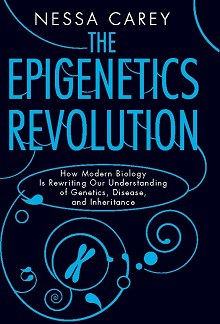
The Epigenetics Revolution: How Modern Biology Is Rewriting Our Understanding of Genetics, Disease, and Inheritance
Author:
Epigenetics can potentially revolutionize our understanding of the structure and behavior of biological life on Earth. It explains why mapping an organism’s genetic code is not enough to determine how it develops or acts and shows how nurture combines with nature to engineer biological diversity. Surveying the twenty-year history of the field while also highlighting its latest findings and innovations, this volume provides a readily understandable introduction to the foundations of epigenetics.
Nessa Carey, a leading epigenetics researcher, connects the field’s arguments to such diverse phenomena as how ants and queen bees control their colonies; why tortoiseshell cats are always female; why some plants need cold weather before they can flower; and how our bodies age and develop disease. Reaching beyond biology, epigenetics now informs work on drug addiction, the long-term effects of famine, and the physical and psychological consequences of childhood trauma. Carey concludes with a discussion of the future directions for this research and its ability to improve human health and well-being.
-
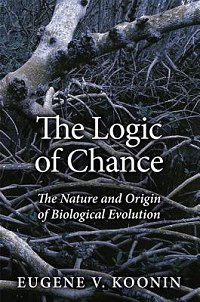
The Logic of Chance: The Nature and Origin of Biological Evolution
Author:
The Logic of Chance offers a reappraisal and a new synthesis of theories, concepts, and hypotheses on the key aspects of the evolution of life on earth in light of comparative genomics and systems biology. The author presents many specific examples from systems and comparative genomic analysis to begin to build a new, much more detailed, complex, and realistic picture of evolution. The book examines a broad range of topics in evolutionary biology including the inadequacy of natural selection and adaptation as the only or even the main mode of evolution; the key role of horizontal gene transfer in evolution and the consequent overhaul of the Tree of Life concept; the central, underappreciated evolutionary importance of viruses; the origin of eukaryotes as a result of endosymbiosis; the concomitant origin of cells and viruses on the primordial earth; universal dependences between genomic and molecular-phenomic variables; and the evolving landscape of constraints that shape the evolution of genomes and molecular phenomes.
An Outline of a Fundamentally New Evolutionary Synthesis Reflecting Key Advances in Genomics, Systems Biology, and Biological Physics
In this ambitious book, Eugene V. Koonin illuminates the gamut of randomness and regularity that is at the heart of life. Pointing the way beyond Modern Synthesis, Koonin brings together new data and concepts in an attempt to achieve a far deeper understanding of the interplay between chance and necessity that drives biological evolution. He explains evolution as a stochastic process based on historical contingency, constrained by requirements for maintaining cell organization and modulated by adaptation. To support his argument, he weaves together multiple conceptual threads: genomic comparisons that illuminate ancestral forms; new insights into pattern, process, and contingency in evolution; advances in the study of gene expression, protein abundance, and other phenotypic molecular characteristics; application of statistical physics to the study of the evolution of genes and genomes; and new perspectives on probability now emerging from modern cosmology.
The Logic of Chance shows why these insights make the twentieth-century scientific consensus about evolution appear outdated and incomplete and outlines a fundamentally new approach: one that is challenging, sometimes controversial, and always firmly rooted in hard science. Coverage includes
- Understanding the forces and patterns of evolution
- Surprising evolutionary reconstructions arising from the comparison of complete genomes
- Is there a tree of life--or a forest?
- How complex eukaryotes arose: tantalizing hints about one of evolutionary biology’s key enigmas
- Biological complexity and entropy: evolutionary lessons from Kolmogorov, Shannon, and Boltzmann
- Robustness, evolvability, and the creative role of noise in evolution
- The Last Universal Common Ancestor, cell origins, and the primordial gene pool
- The key role of viruses and the virus-cell arms race in evolution
- Life’s origin: estimating the probability of “unique events” in the context of modern cosmology
-
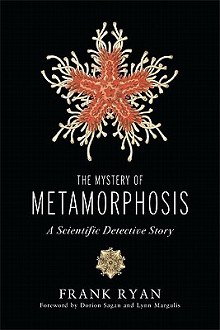
The Mystery of Metamorphosis: A Scientific Detective Story
Author:
How does a caterpillar transform into a butterfly, or plankton-feeding larvae grow into gorgeous sea stars? Metamorphosis has captivated our imagination for thousands of years.Yet it remains, largely, a mystery. Award-winning author Frank Ryan delves into that mystery with the keen eye of a scientist, the skill of an expert storyteller, and the tenacity of a detective tracking down one of science’s least-understood phenomena. What emerges is a brilliant tale of quirky geniuses competing to solve the metamorphosis riddle over the last two centuries. We meet Jean-Henri Fabre, Vincent B. Wigglesworth, and others as they probe deep into the inner workings of insects. We also meet the iconclastic modern-dayscientist Don Williamson, whose studies of marine life led him to the boldest and most controversial theory of evolution since Darwin’s own—one thatsuggests evolution occurs not just through mutationbut also through hybridization. Such a theory could mean that rather than climbing the tree of life, species could possibly jump from branch to branch, and that the origins of metamorphosis might lie in the ancient union of two completely different species.The Mystery of Metamorphosis is an accurate depiction of a scientific revolution 150 years in the making. Nowhere else will readers find such a sweeping account of this strange and wonderful mystery—or such a thoughtful, balanced presentation of why metamorphosis has landed centerstage in debates over evolution itself.
-

Evolution, the extended synthesis
Author:
In the six decades since the publication of Julian Huxley's Evolution: The Modern Synthesis, spectacular empirical advances in the biological sciences have been accompanied by equally significant developments within the core theoretical framework of the discipline. As a result, evolutionary theory today includes concepts and even entire new fields that were not part of the foundational structure of the Modern Synthesis. In this volume, sixteen leading evolutionary biologists and philosophers of science survey the conceptual changes that have emerged since Huxley's landmark publication, not only in such traditional domains of evolutionary biology as quantitative genetics and paleontology but also in such new fields of research as genomics and EvoDevo.
Most of the contributors to Evolution—The Extended Synthesis accept many of the tenets of the classical framework but want to relax some of its assumptions and introduce significant conceptual augmentations of the basic Modern Synthesis structure—just as the architects of the Modern Synthesis themselves expanded and modulated previous versions of Darwinism. This continuing revision of a theoretical edifice the foundations of which were laid in the middle of the nineteenth century—the reexamination of old ideas, proposals of new ones, and the synthesis of the most suitable—shows us how science works, and how scientists have painstakingly built a solid set of explanations for what Darwin called the "grandeur" of life.
Contributors: John Beatty, Werner Callebaut, Jeremy Draghi, Chrisantha Fernando, Sergey Gavrilets, John C. Gerhart, Eva Jablonka, David Jablonski, Marc W. Kirschner, Marion J. Lamb, Alan C. Love, Gerd B. Müller, Stuart A. Newman, John Odling-Smee, Massimo Pigliucci, Michael Purugganan, Eörs Szathmáry, Günter P. Wagner, David Sloan Wilson, Gregory A. Wray