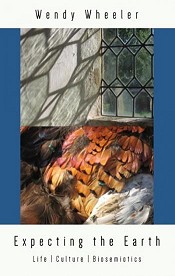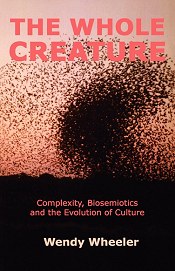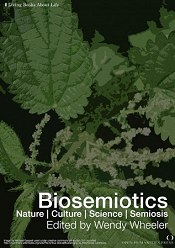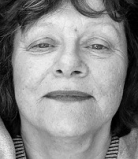

Wendy Wheeler received First Class Honours in English Literature from North London Polytechnic in 1986 and an M.A. in Critical Theory from the University of Sussex in 1987. Her PhD from the University of Sussex was awarded in 1994 for a thesis on postmodernism as cultural mourning and melancholia in the contemporary English novel. In 2009, she was awarded a DLitt from London Metropolitan University. Her first monograph, A New Modernity: Change in Science, Literature and Politics (1999), looked at changes taking place across a number of disciplines which seemed to indicate contemporary endeavours to begin to think through a post-Cartesian, more holistic approach to human selves and the world. The book’s final chapter dealt with the emergence of complex evolutionary systems approaches. Her second monograph, The Whole Creature: Complexity, Biosemiotics and the Evolution of Culture (2006), used biosemiotic systems understandings in order to address the question of the role of biology in a non-reductionist (i.e. non-sociobiological) understanding of culture. The 2001 open-access e-book Biosemiotics is a biosemiotics Reader which introduced Peircean semiotics and process philosophy to an Anglophone audience more familiar with the semiology of F. de Saussure. Wheeler is currently completing her new monograph, The Flame and Its Shadow: Reflections on Nature and Culture from a Biosemiotic Perspective (2015). Wheeler has been a Visiting Research Fellow at the Institute for Advanced Study in the Humanities at the University of Edinburgh (2010) and a Visiting Professor on the Environmental Studies programme at the University of Oregon (2012-13). She is currently Visiting Professor in the Department of Sociology at Goldsmith, University of London, and in the School of Art, College of Design and Social Context, RMIT University, Melbourne, Australia.